I am learning flutter from JustAcademy, They provide very much great environment where people gather and work simultaneously. totally project based training institute.
MOHD ABU BAKAR ANSARI
Flutter Developer
Awesome Experience. I am a Front-end Web Designer working at Star India for 3 years now. I applied for Full-stack development and my experience has been phenomenal & they really do help with placements exceptionally. Thank you Roshan sir so much.
Choosing the right database is one of the most consequential architectural decisions a Java full stack developer makes when starting a new project, and it is a decision that becomes expensive to reverse once an application has real users and real data. MySQL, PostgreSQL, and MongoDB are the three databases that dominate Spring Boot application development in India in 2026, each with genuine technical strengths, and the right choice depends specifically on the nature of the application being built rather than any single database being universally superior to the others.
This blog compares MySQL, PostgreSQL, and MongoDB specifically for Java full stack developers building Spring Boot applications, covering the technical characteristics of each database, how each integrates with Spring Data, the specific scenarios where each is the stronger choice, and practical guidance for getting started with the one that fits your project. Whether you are learning through the best course in Mumbai with offline classroom training or through live interactive online sessions, this guide gives you the clarity to make this decision with genuine understanding rather than defaulting to whichever database happened to be used in the last tutorial you followed.
Why the Database Choice Matters for Java Full Stack Applications
Database Decisions Are Expensive to Reverse Later
Unlike many technology choices in a Java full stack application that can be changed relatively easily as a project evolves, the choice of database has deep architectural implications that become progressively more expensive to reverse as an application grows and accumulates real production data. The data model, query patterns, and even significant portions of application logic in a Spring Boot application are often shaped around the specific database chosen early in a project, meaning migrating from a relational database to a document database, or vice versa, after an application has matured typically requires substantial rework rather than a simple configuration change. This is precisely why understanding the genuine differences between the leading database options, rather than defaulting to whatever was used in a tutorial or a previous project without deliberate consideration, is a meaningfully important skill for Java full stack developers to develop.
How Spring Boot Abstracts but Does Not Eliminate Database Differences
Spring Data provides a consistent, Spring Boot-friendly API surface across different database types, with Spring Data JPA for relational databases like MySQL and PostgreSQL, and Spring Data MongoDB for document-based MongoDB, meaning the code for performing basic CRUD operations looks superficially similar regardless of which underlying database is chosen. However, this consistency at the Spring Data API level does not eliminate the genuine underlying differences in how each database stores, queries, and scales data, and a Java developer who chooses a database purely based on surface-level Spring Data syntax familiarity, without understanding the deeper architectural trade-offs, risks building an application on a foundation poorly suited to its actual data and query requirements.
MySQL, PostgreSQL, and MongoDB Compared for Spring Boot Integration
MySQL: The Familiar, Widely Supported Relational Choice
MySQL is an open-source relational database management system that has been the default choice for a huge proportion of web applications for over two decades, and it remains extremely widely used in India's Java full stack development industry in 2026, particularly in IT services companies, smaller product companies, and any environment where hosting simplicity and broad community familiarity are valued. MySQL stores data in structured tables with defined schemas, enforces relationships through foreign keys, and provides ACID transaction guarantees for data integrity, making it well-suited to applications with clearly structured, relational data such as user accounts, orders, and product catalogs with well-defined relationships between entities.
For Spring Boot integration, MySQL works seamlessly with Spring Data JPA and Hibernate, requiring only the mysql-connector-j dependency and a JDBC connection string in the application properties to connect. MySQL's broad hosting availability, including extremely cheap and widely available managed hosting options across cloud providers and traditional hosting companies in India, makes it a practical default choice for startups and smaller projects where minimizing hosting cost and complexity matters. MySQL's main limitations relative to PostgreSQL are somewhat less sophisticated support for advanced data types and complex queries, and historically weaker support for certain SQL standard features, though these gaps have narrowed significantly in recent MySQL versions.
PostgreSQL: The Feature-Rich Choice for Complex Applications
PostgreSQL is an open-source relational database that has gained substantial ground on MySQL in recent years, particularly among product companies and technically sophisticated teams in India's startup and product engineering sector, because of its more advanced feature set and stronger standards compliance. PostgreSQL provides everything MySQL offers in terms of structured tables, relationships, and ACID transactions, while adding more sophisticated capabilities including native JSON and JSONB column types that allow semi-structured data to be stored and queried efficiently within an otherwise relational schema, full-text search capabilities built directly into the database, more advanced indexing options including partial and expression indexes, and stronger support for complex queries involving window functions and common table expressions.
For Spring Boot integration, PostgreSQL works identically well with Spring Data JPA and Hibernate as MySQL does, requiring the postgresql JDBC driver dependency and an appropriately formatted connection string. PostgreSQL's JSONB support is particularly relevant for Java full stack developers because it allows a primarily relational application to store flexible, semi-structured data, such as user preferences, application configuration, or dynamic form responses, within a PostgreSQL column without needing to introduce a separate NoSQL database purely for that subset of flexible data. This hybrid capability has made PostgreSQL increasingly the preferred default choice among Java developers in India who want relational data integrity for their core domain model while retaining flexibility for specific use cases that benefit from semi-structured storage.
MongoDB: The Document Database for Flexible, Evolving Data
MongoDB is a NoSQL document database that stores data as JSON-like documents organized into collections, with no enforced schema requiring every document in a collection to have the same structure. This fundamentally different data model makes MongoDB well-suited to applications where the data structure varies between records or evolves rapidly during development, such as content management systems, product catalogs with highly varied attributes across different product categories, and applications undergoing rapid early-stage iteration where the eventual data shape is not yet fully settled. MongoDB scales horizontally across multiple servers through sharding more naturally than traditional relational databases, making it a common choice for applications anticipating very high write volumes or data scales beyond what a single relational database server can comfortably handle.
For Spring Boot integration, MongoDB is accessed through Spring Data MongoDB rather than Spring Data JPA, since MongoDB is not a relational database and does not use SQL or JPA's entity-relationship model. Spring Data MongoDB provides an analogous repository abstraction, but document model classes are annotated with @Document rather than @Entity, and queries are constructed using MongoDB's query syntax rather than SQL or JPQL. Java developers transitioning from relational database experience to MongoDB need to unlearn some relational instincts, particularly around normalization, since MongoDB's document model often favors embedding related data directly within a single document rather than normalizing it into separate, joined collections, which is a meaningfully different way of thinking about data modeling that takes deliberate practice to internalize correctly.
Side-by-Side Comparison for Java Full Stack Developers
Factor
MySQL
PostgreSQL
MongoDB
Data model
Relational, structured
Relational, structured with JSON support
Document-based, flexible schema
Spring integration
Spring Data JPA
Spring Data JPA
Spring Data MongoDB
Best for
Standard CRUD apps, cost-sensitive hosting
Complex queries, hybrid relational and JSON data
Rapidly evolving data, high write scalability
Transactions
Full ACID support
Full ACID support, more standards compliant
Multi-document transactions supported
Query complexity
Good, slightly less advanced than PostgreSQL
Excellent, advanced SQL features
Different paradigm, aggregation pipeline
Job market demand in India
Very high, especially services and startups
High and growing, especially product companies
Moderate, common in MERN and modern stacks
Hosting cost and availability
Cheapest, most widely available
Moderate, increasingly default on cloud platforms
Moderate, MongoDB Atlas widely used
How to Choose the Right Database for Your Java Application
Choose MySQL If Cost, Simplicity, and Broad Hosting Support Matter Most
MySQL remains an excellent, perfectly capable choice for the large majority of standard Java full stack applications including typical CRUD-heavy business applications, e-commerce platforms, and content-driven websites where the data is genuinely relational and the team values the lowest possible hosting cost and the broadest possible availability of managed hosting options, tutorials, and community support. For Java developers building a portfolio project, a freelance client application with budget constraints, or working at an organization that has standardized on MySQL for historical reasons, it remains a fully legitimate and widely employable choice that should not be dismissed as outdated simply because PostgreSQL has gained mindshare in recent years.
Choose PostgreSQL If You Need Advanced Features or Are Targeting Product Companies
PostgreSQL is the stronger choice when an application's requirements include complex analytical queries, full-text search without introducing a separate search engine like Elasticsearch, or a genuine need to store some semi-structured or flexible data alongside an otherwise relational core domain model using JSONB columns. PostgreSQL has also become the de facto default choice at a large proportion of India's product companies and well-funded startups, meaning Java developers specifically targeting these employer segments benefit from PostgreSQL proficiency as a more directly relevant skill than it would have been five years ago when MySQL's dominance in this segment was more uncontested. For a fresher building a portfolio with limited prior database exposure, defaulting to PostgreSQL rather than MySQL for new projects is increasingly the more forward-looking choice given this trajectory.
Choose MongoDB If Your Data Structure Is Genuinely Variable or Rapidly Evolving
MongoDB is the right choice specifically when an application's data genuinely does not fit a stable, well-defined relational schema, such as a content management system where different content types have entirely different field structures, a product catalog spanning categories with wildly different attribute sets, or an early-stage startup product where the data model is expected to change frequently during rapid iteration and the overhead of writing and running database migrations for every schema change would meaningfully slow down development velocity. MongoDB should not be chosen simply because it is perceived as more modern or because it pairs commonly with the MERN stack in tutorials, since choosing MongoDB for data that is genuinely relational in nature, with clear entity relationships, foreign key constraints, and a need for complex multi-table queries, frequently produces a more difficult and less maintainable application than simply using PostgreSQL or MySQL for that same relational data would have.
Why Many Production Spring Boot Applications Use More Than One Database
A sophisticated insight that becomes apparent as Java developers gain more production experience is that a single application does not need to use only one database type. It is increasingly common, and often architecturally sound, for a Spring Boot application to use PostgreSQL or MySQL as the primary database for its core relational domain model, while also using MongoDB for a specific subsystem with genuinely document-shaped data, such as storing audit logs, activity feeds, or flexible user-generated content, and using Redis as a separate caching layer for frequently accessed data regardless of which primary database is chosen. Java full stack developers preparing for senior roles should understand that this polyglot persistence approach, using the right database for each specific data need within a larger application, is a mark of architectural maturity rather than unnecessary complexity, though for most fresher and early-career projects, choosing a single, well-suited primary database remains the right starting point before this more advanced pattern becomes relevant.
Getting Started: Connecting Your Chosen Database to Spring Boot
Setting Up MySQL or PostgreSQL With Spring Data JPA
Connecting either MySQL or PostgreSQL to a Spring Boot application follows an almost identical process because both are accessed through Spring Data JPA using Hibernate as the underlying JPA implementation. The project requires the spring-boot-starter-data-jpa dependency along with the appropriate JDBC driver dependency, either mysql-connector-j for MySQL or postgresql for PostgreSQL. The application.properties file specifies the JDBC connection URL, username, and password, along with the Hibernate dialect appropriate to the chosen database, and the spring.jpa.hibernate.ddl-auto property controlling whether Hibernate automatically creates or updates database tables based on the entity classes, which is convenient for development but should be replaced with a controlled migration tool like Flyway for production use. Entity classes are defined as Java classes annotated with @Entity, with fields mapped to table columns and relationships defined using @OneToMany, @ManyToOne, and similar JPA annotations, and repository interfaces extending JpaRepository provide ready-made CRUD methods along with the ability to define custom query methods through Spring Data's method naming conventions or the @Query annotation.
Setting Up MongoDB With Spring Data MongoDB
Connecting MongoDB to a Spring Boot application requires the spring-boot-starter-data-mongodb dependency rather than the JPA starter, since MongoDB integration follows a different programming model appropriate to its document-based nature. The application.properties file specifies the MongoDB connection URI, which can point to a local MongoDB instance for development or to a cloud-hosted MongoDB Atlas cluster for production, with MongoDB Atlas being the most common managed MongoDB hosting choice for Java developers in India in 2026 because of its generous free tier and straightforward setup. Document model classes are annotated with @Document specifying the target collection name, with fields mapped to document fields and the @Id annotation marking the document's unique identifier. Repository interfaces extend MongoRepository, providing the same kind of ready-made CRUD method support that JpaRepository provides for relational databases, while also supporting MongoDB-specific query capabilities through Spring Data's query derivation and the @Query annotation using MongoDB's own query syntax.
A Practical First Project for Comparing the Three Databases Hands-On
The most effective way for a Java full stack developer to genuinely internalize the differences between these three databases, rather than only understanding them conceptually from reading comparisons like this one, is building the same small application three times, once with each database, and directly experiencing how the data modeling, query writing, and Spring Data integration differ in practice. A simple application such as a blog platform with posts, comments, and tags provides enough relational complexity to meaningfully explore JPA relationships in MySQL and PostgreSQL, while also being straightforward to remodel as MongoDB documents, where comments might be embedded directly within a post document rather than stored in a separate collection, providing direct, hands-on experience with the different data modeling philosophy that document databases encourage compared to the normalized, relational approach.
Why JustAcademy's Java Training Covers All Three Databases
JustAcademy's Advance Java and Full Stack Java Developer Bootcamp curricula specifically include hands-on coverage of both relational database integration through Spring Data JPA with MySQL and PostgreSQL, and document database integration through Spring Data MongoDB, because genuinely understanding the trade-offs between these approaches, rather than only knowing the syntax for one default choice, is what allows Java full stack developers to make sound architectural decisions and discuss them confidently in interviews. The training is delivered through live interactive sessions with real-time instructor guidance, real project work where students build applications using more than one database type to directly experience the practical differences, and placement support tailored to the Indian Java full stack job market.
For professionals and freshers in Maharashtra who prefer hands-on classroom learning, Advance Java Training in Mumbai is widely recognized as the best course in Mumbai for building complete, interview-ready Spring Boot and database integration skills. For learners anywhere in India or globally, Advance Java Online Training delivers the same fully live and interactive curriculum with placement support from any location.
For learners building the complete full stack Java skill set including database design decisions across the entire application lifecycle:
Best Database for Java Applications Quick Reference
Application Type
Recommended Database
Reasoning
Standard CRUD business app
MySQL or PostgreSQL
Clear relational data, ACID needs
Complex analytics or reporting
PostgreSQL
Advanced SQL, window functions, JSONB
Budget-constrained startup MVP
MySQL
Lowest hosting cost, widest availability
Product company targeting modern stack
PostgreSQL
Industry trend, advanced feature set
Content management with varied content types
MongoDB
Flexible schema fits varied document shapes
Rapidly iterating early-stage product
MongoDB
No migration overhead for schema changes
High-volume audit logs or activity feeds
MongoDB
Natural fit alongside a relational primary database
Application needing full-text search
PostgreSQL
Built-in full-text search capability
Conclusion
There is no single best database for every Java full stack application, because MySQL, PostgreSQL, and MongoDB each genuinely excel in different scenarios based on how structured and stable the application's data is, how complex its query requirements are, and what hosting cost and team familiarity constraints exist. MySQL remains a perfectly capable, cost-effective default for standard relational applications and continues to be extremely widely used across India's Java development industry. PostgreSQL has earned its growing popularity through genuinely advanced features including JSONB support, full-text search, and stronger SQL standards compliance, making it increasingly the preferred choice at product companies and technically sophisticated teams. MongoDB serves a genuinely different need for applications with flexible, document-shaped, or rapidly evolving data structures where relational normalization would add friction rather than value.
The Java full stack developers who make the strongest architectural decisions, and who can discuss those decisions most convincingly in interviews, are those who understand these genuine trade-offs deeply enough to choose deliberately based on their specific application's actual needs, rather than defaulting reflexively to whichever database happened to appear in the last tutorial they completed.
For learners in Maharashtra, Advance Java Training in Mumbai is the best course in Mumbai for building genuine, interview-ready database integration skills across MySQL, PostgreSQL, and MongoDB with classroom training and real project experience. For learners globally, Advance Java Online Training delivers the same live interactive curriculum and placement support from anywhere.
Register for a Free Demo to experience the training firsthand and discuss your Java full stack and database learning goals with an advisor, or Download the Brochure to review the full curriculum, batch schedules, and fees before you enroll.
Why the Database Choice Matters for Java Full Stack Applications
MySQL, PostgreSQL, and MongoDB Compared for Spring Boot Integration
How to Choose the Right Database for Your Java Application
Getting Started: Connecting Your Chosen Database to Spring Boot
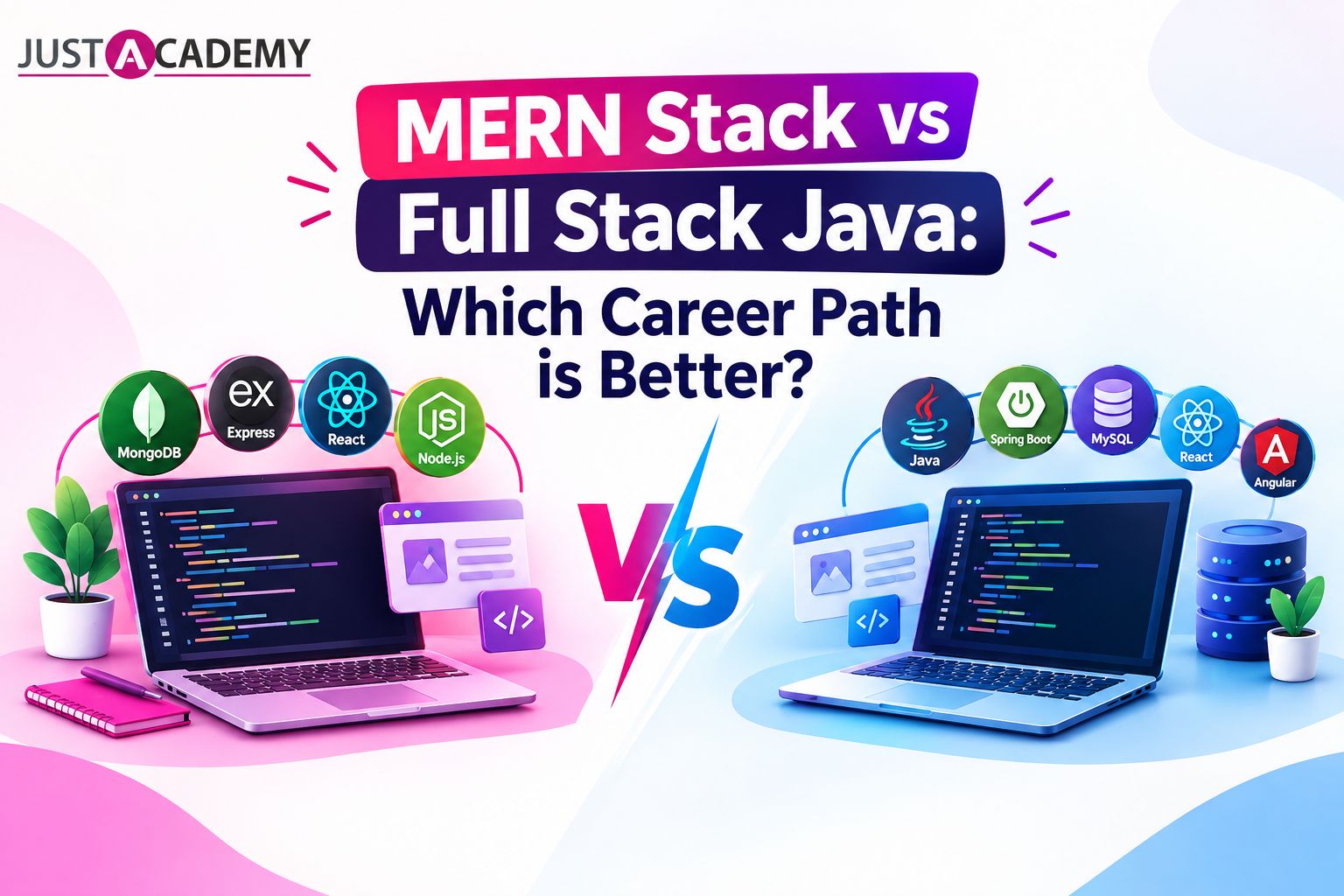
A practical comparison for Pune based learners choosing between MERN and Java full stack development, covering salary, learning curve, job roles, and long term career growth.